
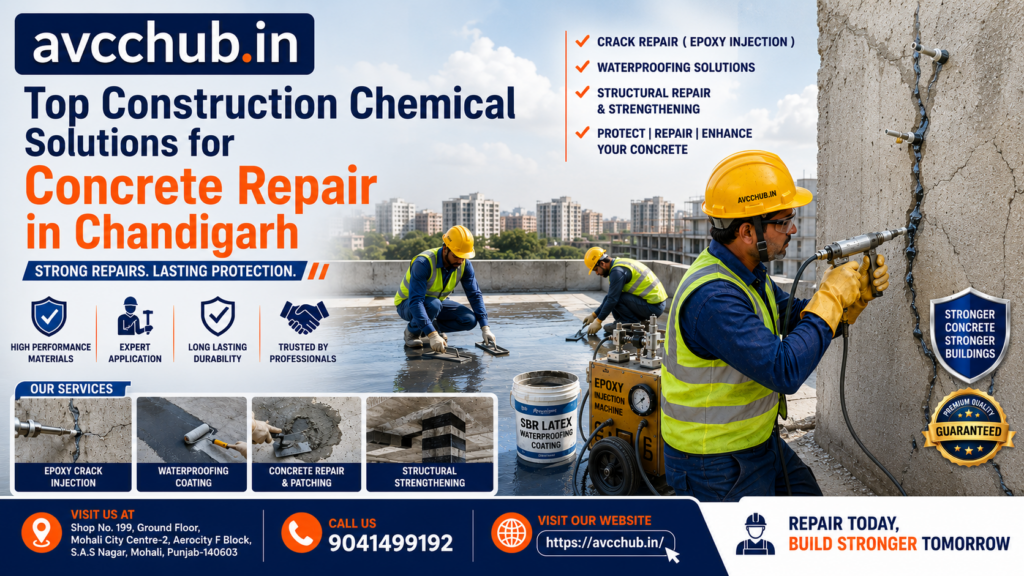
“Good concrete repair is not about hiding the damage. It is about making sure the damage never comes back.”
When concrete starts to crack, most people assume it is just a surface issue that can wait. The truth is, concrete damage rarely stays where it started. A small crack in a slab or a little bit of peeling on a wall is often the first sign of something deeper going on, moisture getting in, steel reinforcing bars starting to rust, or the structure slowly losing the strength it was built with.
This is especially true in Chandigarh, where buildings go through intense summer heat, heavy monsoon rains, and cold winters , all within a single year. That kind of climate puts real stress on concrete, and it shows over time.
The good news is that most concrete problems, when caught early enough, can be fixed properly using the right construction chemical solutionsfor concrete repair in Chandigarh. These are not generic products off a shelf. They are purpose-built repair systems , each designed to handle a specific type of damage, in a specific kind of environment.
This blog walks you through the most commonly used and most effective repair solutions available today, what each one does, and how to know which one is right for your situation.
Common Concrete Problems in Chandigarh
Before getting into solutions, it helps to understand what kind of damage is actually common here. Chandigarh’s weather cycle, hot summers, humid monsoons, and dry cold winters , causes concrete to expand and contract repeatedly. Over time, that movement creates stress the material cannot always absorb quietly.
Here are the problems that come up most often:
- Cracks in beams, columns, and slabs: These form due to excess load, soil settlement under the foundation, or steel reinforcement that was not placed correctly during construction.
- Spalling (concrete breaking off in chunks): This usually happens because the steel inside has started rusting. Rust expands and pushes the concrete layer off from inside.
- Rusting reinforcement: Once moisture and carbon dioxide get past the concrete cover, the steel inside starts corroding. This is the most common reason buildings deteriorate faster than they should.
- Water leakage through terraces and basement walls: Water finds the smallest gap. Once it gets in, it weakens the structure from within.
- Surface wear on floors and facades: Industrial floors and exterior surfaces lose their protective layer over time, leaving the concrete underneath exposed and vulnerable.
Each of these problems has a different cause, and each needs a different fix. That is where the right concrete repair services in Chandigarh make all the difference.
Top Construction Chemical Solutions for Concrete Repair
1. Crack Injection Systems (Epoxy & PU Injection)
Crack injection is one of the most precise and widely used crack repair solutions in Chandigarh, and for good reason. It goes directly into the crack, fills it completely, and either bonds the two sides together or seals it to stop water entry.
There are two main types used in professional repair work:
- Epoxy Injection works best for cracks that are not moving and are not wet. The epoxy resin is injected under low pressure and flows into the crack, bonding both sides together. Once it sets, the repaired zone is often stronger than the surrounding concrete. This is the right choice for structural cracks in columns, beams, foundations, and slabs where you need the concrete to behave as one solid unit again.
- Polyurethane (PU) Injection is the better choice when a crack is actively leaking or still showing slight movement. PU resin reacts with the moisture inside the crack and forms a flexible, waterproof seal. It does not make the crack rigid , it accommodates small movements while keeping water out.
Choosing the right one comes down to four things:
- Is the crack structural or non-structural?
- Is water actively coming through it?
- How wide and deep is it?
- What kind of load will it carry after repair?
Getting this assessment right before injecting is critical. Applying epoxy to an active, wet crack, for example, will not hold. A proper diagnosis always comes before the fix.
2. Polymer-Modified Repair Mortars
When concrete has physically broken away , through spalling, chipping, or surface damage , you need to rebuild that section. Polymer-modified repair mortars are the standard material used for this in professional concrete repair services in Chandigarh.
These are cement-based mortars that have been blended with polymer additives, usually acrylic or styrene-butadiene latex. What the polymer does is improve the mortar in ways that plain cement simply cannot match.
Here is what makes them a better choice for repair work:
- They bond much more strongly to the existing concrete surface, which means the patch stays in place and does not peel off after a year or two.
- They let in very little water or gas, which protects the steel reinforcement inside from getting corroded again.
- They shrink less during curing, so the repaired section does not crack or pull away from the edges as it dries.
- They work well with protective coatings applied on top after the repair is complete.
Surface preparation before applying these mortars is non-negotiable. The damaged concrete has to be removed cleanly, the exposed steel has to be treated, and a bonding primer has to go on before the mortar. Skipping any of these steps is what causes patches to fail within months.
3. Micro Concrete (Non-Shrink Grouts)
Some repair jobs involve spaces that are too tight, too deep, or too awkward for standard repair mortar. Column jacketing, repairs under beams, and machine foundation work are good examples. For these situations, micro concrete and non-shrink grouts are the right tools.
Micro concrete is a flowable, self-compacting repair material. Its particle size is finer than regular concrete, which allows it to flow into narrow spaces and fill them completely without needing vibration. It also has an expansive quality during the setting phase that compensates for any shrinkage, so there are no voids left behind.
Non-shrink grouts serve a similar purpose but are typically used where dimensional accuracy is important , for example, when grouting base plates for structural steel columns, anchoring precast panels, or setting precision equipment foundations. The key property here is that the grout does not pull back from the surrounding surfaces as it hardens.
Both of these are well-established building repair chemicals in infrastructure and industrial repair work across Punjab and Chandigarh, particularly on bridges, flyovers, and heavy manufacturing plants.
4. Waterproofing Chemicals
Water is the root cause of a large share of concrete deterioration. When moisture gets into concrete consistently, it accelerates carbonation, triggers corrosion in the steel reinforcement, and slowly breaks down the bond between the aggregate and the cement paste. Waterproofing is therefore not just a finishing treatment , it is a core part of any serious repair strategy.
There are three main types used in concrete repair work:
- Crystalline waterproofing agents work from inside the concrete. When applied to the surface, they penetrate the pores and react with moisture and calcium compounds to form insoluble crystals that physically block water pathways. These are particularly effective in basements, underground structures, and water-retaining walls.
- Cementitious polymer-modified coatings are applied as a surface membrane and form a tough, flexible, waterproof layer. These are commonly used on terraces, balconies, podium slabs, and planter areas where water sitting on the surface is a regular concern.
- Elastomeric membranes: acrylic or polyurethane-based, are used where the surface is subject to movement, thermal expansion, or dynamic loading. These coatings can bridge hairline cracks that form after application, which is a real advantage in Chandigarh’s temperature-variable climate.
One thing worth emphasizing: No waterproofing chemical will perform well over a poorly prepared surface. The concrete has to be clean, sound, and free of active cracks before any coating goes on. Applying waterproofing over damaged or dusty concrete is a short-term fix that almost always fails.
5. Corrosion Protection Chemicals
Steel reinforcement corroding inside concrete is the most widespread structural problem in Indian buildings, and Chandigarh is no exception. Once the concrete cover carbonates or chloride ions reach the steel surface, the passive protective layer that keeps the steel intact breaks down. Corrosion begins, rust forms, and the rusted steel expands , cracking and pushing off the concrete cover from within.
Dealing with this properly requires more than just patching the surface. The whole sequence needs to be followed:
- Remove all the concrete around the corroded area cleanly and to a sufficient depth.
- Clean the steel thoroughly using wire brushing or grit blasting to get rid of rust and loose scale.
- Applying a corrosion inhibitor coating to the cleaned steel bars , zinc-rich epoxy primers and migrating inhibitor systems are commonly used , to stop the corrosion process from restarting.
- Rebuild the concrete section using polymer-modified repair mortar to restore the cover.
- Finish with an anti-carbonation topcoat on the surface to prevent carbon dioxide from getting back into the concrete and starting the whole cycle again.
This is where quality building repair chemicals matter most. Cutting corners on the steel treatment step is the single most common reason corrosion-related repairs fail and come back within a few years.
Did You Know?
Research by CSIR-Central Electrochemical Research Institute (CSIR-CECRI), a Government of India laboratory, found that concrete structures with unprotected steel reinforcement can deteriorate in under 5 years in aggressive environments, while structures treated with proper corrosion protection coatings can achieve a service life of up to 80 years. This is precisely why using the correct construction chemical solutions for concrete repair in Chandigarh makes such a significant long-term difference.
Why Construction Chemicals Are Important
Using the right construction chemical solutions for concrete repair in Chandigarh is not just about fixing what is visibly broken. It has broader implications that building owners and facility managers should keep in mind:
- Safety comes first. Spalling concrete and corroded structural members are genuine hazards. A properly repaired structure removes those risks and gives you documented proof of the work done.
- Repair is far cheaper than reconstruction. Fixing a problem early, using the right materials, costs a small fraction of what a full teardown and rebuild would demand later.
- Structures last significantly longer. When repairs are paired with protective coatings and surface treatments, the service life of the building extends by years , sometimes decades.
- It is the more sustainable choice. Rehabilitating an existing structure consumes far fewer resources than demolishing and rebuilding. From both an environmental and a cost perspective, good repair makes sense.
- It keeps you compliant. Commercial and industrial buildings are subject to structural safety standards. A professionally done repair, properly documented, gives you the evidence that your building meets those requirements.
Choosing the Right Concrete Repair Solution in Chandigarh
With several repair systems available, the question of which one to use is not always straightforward. The honest answer is: it depends on the specific damage, and there is no substitute for a proper inspection before making that call.
Here are the key things that should guide the selection:
- What kind of damage is it? A crack behaves differently from spalling, which behaves differently from surface erosion. Each needs a different approach.
- Why did the damage happen? If the root cause is not identified and addressed, the repair will not last. Water ingress from a faulty drain, for example, will undo any repair if the drain is not fixed.
- What is the condition of the surrounding concrete? If the parent concrete is weak or contaminated, a repair applied over it will not hold for long without additional preparation.
- What is the structure exposed to? Temperature swings, chemical exposure, heavy traffic loading, and moisture all affect which repair system is appropriate.
- Will there be movement? Some structures flex slightly under load. A rigid repair material in a flexible situation will crack again. The repair chemistry has to suit the structural behaviour.
- Does the repair material need to work with a topcoat? Compatibility between the repair mortar and any protective coating applied afterwards matters more than most people realize.
A site inspection covering visual assessment, non-destructive testing like rebound hammer checks, and carbonation depth measurement, gives you the information needed to make the right call. In Chandigarh and across the Punjab region, AVCC Hub (AV Construction Chemical Hub) provides exactly this kind of structured, assessment-first approach, working across residential, commercial, industrial, and infrastructure projects.
Key Takeaways
Before you move to the conclusion, here is a quick summary of the most important points from this blog:
- Concrete damage never stays small. A hairline crack today can turn into a serious structural problem within one or two monsoon seasons if left unattended.
- Not all cracks are the same. Epoxy injection works for dry, structural cracks. Polyurethane injection is the right choice when a crack is wet or still moving. Using the wrong one will not hold.
- Polymer-modified mortars outperform regular cement in every way that matters for repairing better bonds, less shrinkage, and far lower water absorption.
- Waterproofing is part of repair, not just finishing. Applying a protective coating after repair is what keeps the fix from failing early. Learn more about complete waterproofing solutions that work alongside repair systems.
- Rusting steel is the number one enemy of concrete structures in India. According to CSIR (Government of India), structures with unprotected reinforcement can fail in under 5 years in aggressive environments.
- Surface preparation is non-negotiable. No repair chemical however good will perform on a dirty, weak, or unprepared substrate.
- Repairing early is always cheaper than rebuilding later. Timely use of the right construction chemical solutions for concrete repair in Chandigarh saves significantly more money in the long run.
- Every repair starts with a proper diagnosis. Identifying the root cause before selecting a repair system is what separates a lasting fix from a temporary patch. Book a free site visit to get that process started.
Conclusion
Concrete repair, done properly, is one of the most practical and cost-effective investments a building owner can make. It does not have to be complicated, but it does have to be done right.
The structures in Chandigarh deal with a tough climate and heavy use year after year. A crack that gets ignored today becomes a spall next monsoon season, and a structural problem the year after that. The way to break that cycle is to use the correct construction chemical solutions for concrete repair in Chandigarh, applied by people who understand what is actually happening inside the concrete, not just on the surface.
Whether you are managing a residential building, running an industrial facility, or overseeing a commercial property, the principle is the same: get a proper assessment, use the right materials, and do not skip the surface preparation or the protective finish. That is what makes a repair last.
Frequently Asked Questions:
Q1. What are the best construction chemical solutions for concrete repair in Chandigarh?
The best solution depends on the type of damage. Epoxy injection works for structural cracks, polymer mortars for spalled or broken sections, crystalline agents for water ingress, and corrosion inhibitor coatings where steel reinforcement has started to rust. You can explore the available concrete repair services to find the right fit for your structure.
Q2. How do crack repair solutions in Chandigarh work for structural cracks?
Structural cracks are injected with epoxy resin under controlled low pressure. The resin fills the crack completely, bonds both sides together, and restores the load-carrying capacity of the element. The Indian Roads Congress guidelines provide technical standards that govern how such repairs are specified on infrastructure projects.
Q3. When should I use building repair chemicals instead of regular cement mortar?
Regular cement mortar shrinks during curing, bonds poorly to old concrete, and lets water through. Building repair chemicals, especially polymer-modified mortars, grip the substrate firmly, resist moisture, and stay in place far longer under real conditions. The Bureau of Indian Standards (BIS) codes outline the minimum performance requirements for materials used in structural repair.
Q4. How often do concrete repair services in Chandigarh need to be repeated?
A repair done with quality materials and a proper protective finish should last well over a decade without needing attention. The most common reason repairs fail early is skipping the surface preparation or leaving out the protective topcoat. Pairing repair work with a reliable waterproofing solution significantly extends the life of any repair.
Q5. Can I carry out concrete repair without getting a professional assessment first?
It is not advisable. Without knowing the cause and extent of the damage, there is a real risk of applying the wrong fix which can mask the problem temporarily while it continues to worsen underneath. Reaching out for technical support before starting any repair is always the smarter first step.